Damien and I have a monk friend, who does a lot of monkery according to the rule of St Benedict, whose teaching on wine he finds most agreeable. His prime focus is the sacred liturgy, and he devotes a lot of his time to helping others with their liturgical formation. He's a wonderful man. A point to which he always returns is the necessity of beauty infiltrating all the senses in order to elevate the mind to a level of transcendent worship of the one God, Living and True. Nothing is more important than this - in the gospel our Lord chastises Martha for worrying about everything, and praises Mary for choosing to spend time with Him. The Catholic Church has in recent times done a fairly poor job where beauty is concerned; translations are increasingly ugly, the mass has been thinned out, and music is all over the place. As a linguist, the translations are the part I find most repugnant. I want to look at the Common Book of Prayer and see how the Anglicans are doing for beauty.
The first thing which strikes one when looking at this little book of heresy is that there is a huge amount of variety. "I confess to Almighty God..." may be nice and convenient, but is there any reason at all why things couldn't be spiced up? Check out these little prayers of confession for Christmas (there are several according to the time of year/occasion):
"The Virgin Mary accepted your call to be the mother of Jesus. Forgive our disobedience to your will. We have sinned: forgive us and heal us."
Or this:
"The wise men followed the star to find Jesus the King. Forgive our reluctance to seek you. We have sinned: forgive us and heal us."
The Roman Missal does of course have season specific prayers, but they absolutely drench the Anglican liturgy, and it is beautiful.
The second thing which strikes one is the antiquity of the language, particularly in the psalter. Anglicans don't seem to think that the common man is so stupid that leaving in traditional second and third person singular verb endings and the second person pronouns would completely confound him. Nor are they afraid to use words whose meanings have changed but remain perfectly clear from the context. These principles create truly beautiful translations, such as this:
"...He sitteth at the right hand of God, the Father Almighty,
He shall come again to judge the quick and the dead.
I believe in the Holy Ghost,
The Holy Catholick Church..."
or
"...He remembering His mercy,
Hath holpen his servant Israel,
As He promis'ed to Abraham and his seed, forever."
The sense of tradition, the sense that one is pronouncing the same creed as our forefathers since the 16th century, not 2008, is profound and important. It reminds us that we are not saying the creed 2000 years after the death of Christ, but throughout all ages. This is one of the motivations for using Latin, but just because we have translated the missal from Latin doesn't mean we ought to throw away the underlying principles of beauty of language, as indeed we have.
I'm writing this primarily because I love Anglican things, and I don't actually expect the Church to change anything because some anonymous, indignant student writes a blogpost complaining about Her dreadful choices. Nevertheless, I really really hope that someone, somewhere in the Vatican, has common sense enough to stop this awful 'Good News' business where the text should quite clearly read, 'The Gospel'.
Sunday, 29 September 2013

Friday, 27 September 2013
Uh Oh
We've heard a rumour that we may be hearing more of the man on the right in the coming days. The man on the right being responsible for the fiasco going on in the very immediate vicinity of Pope Benedict at the time.
 |
| Pope Benedict having been dressed up as the Atlantic |
Thursday, 26 September 2013
I've worked out why the priest was so distracted, irritated and yelpy the other week. He must have been infested with flees from all the poor people he'd so kindly been looking after.
Not that scary
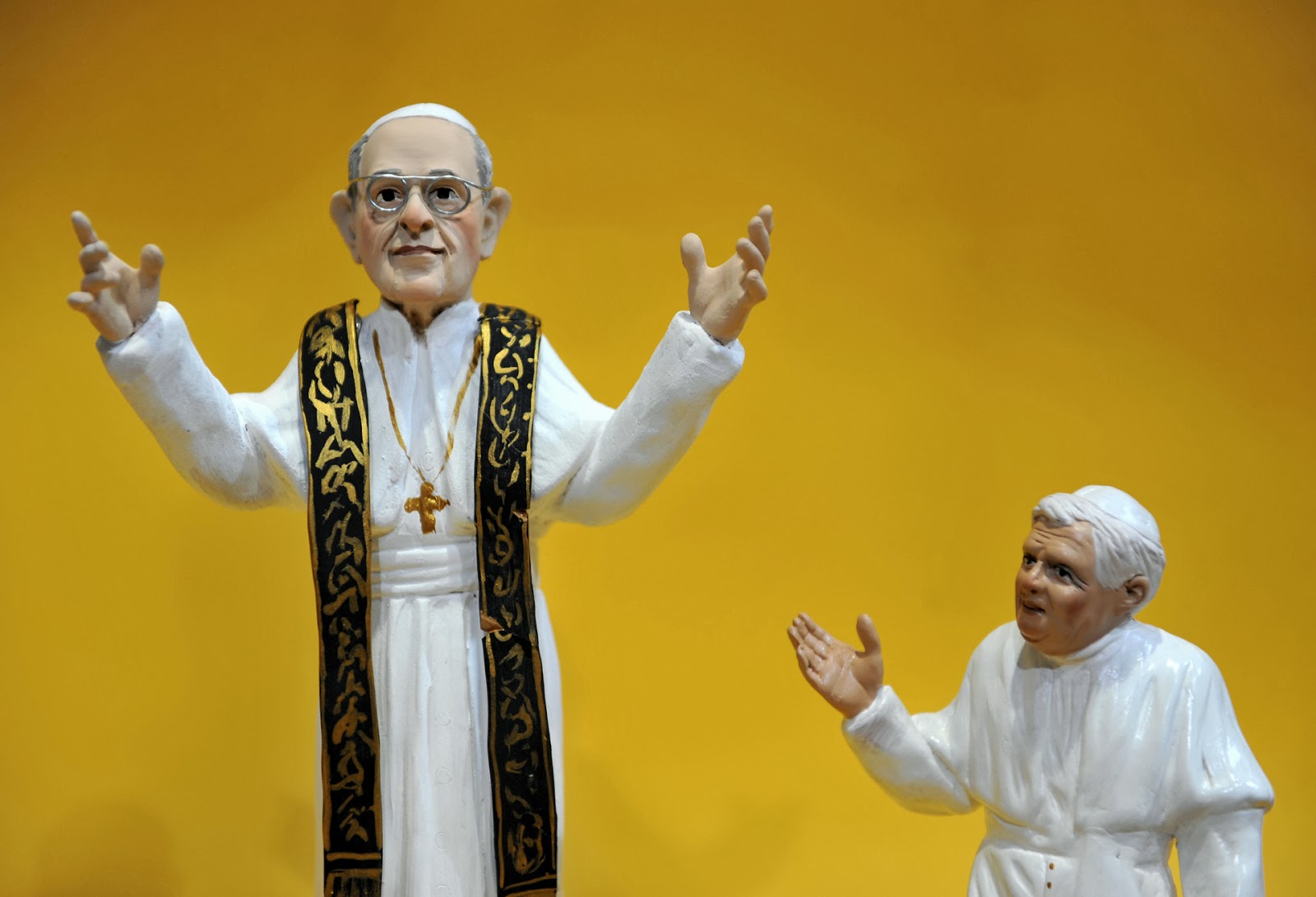 |
| The Francis Libby created in her own image seems not to bear much resemblance to the real Pope |
I read an article by Libby Purves in The Times this week which seemed to me not really to be representative of Pope Francis. It showed, in part, a pope of whom I would be scared and in part just an ignorance of who and what Pope Francis is. If it was a Pope Francis that existed in real life then I think I might have had good reason to be scared.
The first and obvious fault of hers was to suggest some sort of dichotomy between Benedict XVI and Francis. I don't mean this in a inflicting-one's-own-opinions-upon-Benedict-and-then-onto-Francis kind of Fr Z way, but rather that she seemed to present a picture of Benedict which would have opposed Francis had it actually ever existed in the real world. She described him as "a rigid German", conjuring the media myth of the jackbook wearing rottweiler with an obsession with regulations and imposing it on the cuddly professor from Regensburg and then proceded to make a list of misrepresentations of both. The first on her list was inevitably homosexuality. Francis has yet to say anything about homosexuality. He has spoken about the innate value of people who are homosexual and that's a very different kettle of fish, though he seems to have caught them in the same pond as Benedict who said "It is deplorable that homosexual persons have been and are the object of violent malice in speech or in action. Such treatment deserves condemnation from the church's pastors wherever it occurs". Then came the role of women in the Church ("It is theologically and anthropologically important for woman to be at the center of Christianity"... said Benedict XVI).
The next bit brought a snort from deep within the walls of Lazarus College. She described Catholicism as "legalistic, literal, authoritarian fundamentalism". My suspicion is that she just thought up some epithets commonly applied to religion without giving too much thought to which ones she used. Some people within the Church are certainly guilty of all three, but the idea that the Church advocates that or that it's common would be tricky to defend. Legalistic in the sense that we have laws which are applied, yes. But they tend to be about things like clergy fiddling the books or the altar boys. As it goes, I'm quite keen to keep those laws. We have laws about clergy not misleading their people too: an australain priest was defrocked and excommunicated by Pope Francis recently for teaching contrary to the Church. This is I suspect what she is getting at, but she needs to remember what the role of a priest is. He is there to pass on faithfully what the Church says. He may have a myriad of personal opinions, but he ought to have the humility to know that his opinions are not what his parisioners need from their priest. They can get whacky notions from reading The Tablet. It takes a fairly extreme situation, like the one in Australia, for the legal mechanisms of the Church to be put into actions. As for the importance of observing Catholic practices, which is the other thing I think she's getting at, maybe asking why they are there would be good before discarding them without a thought. She gives the example of "no-meat Fridays, not joining the Freemasons, Sunday Mass and Holydays of Obligation". These aren't ends in themselves, they're a way of improving and protecting our relationship with God. We don't think for a moment we can understand God with these rules, but they create an environment in which we can start to meet Him.
I remember when Pope Benedict was elected in 2005. He didn't know how to be pope. He'd never wanted to be one and never expected to be so had not prepared for it. The obvious example is that of the Regensburg address when he was just an excited professor who'd found an amazing quotation from a historical source. With Benedict it was easier because he wasn't trying to reform the curia so let them reign him in a bit. Francis needs to get some heads rolling, so can't take the chance of letting any of them control him. It's a tricky situation, I could never do it as well as he seems to be doing it, so I'll keep him in my prayers and take him as an example of Christian living.
Pope Francis is a Jesuit through and through. In one or two respect he even shows what generation of Jesuit he is, but you can tell a lot about a man from his enemies. In the past that's meant other South American Jesuits. Today it means the curia. That speaks volumes.
As an aside, I think we'll see Pope Francis helping greatly with the vocations shortage we're experiencing. I think that it's easy to make sacrifices for a person but that it's hard to make sacrifices for an idea. For so long as we make Catholicism a cerebral exercise, as is so tempting with a religion founded on logic, we create an idea. When we realise that actually it's all about a person and the relationship we have with Him, it suddenly becomes a lot easier. In the situations where the relationship with the Lord draws a person towards His priesthood, then I suspect it will be easier for men to make the sacrifices necessary when the bloke in the white cassock is so obviously not viewing his faith in terms of intellectualism but in terms of that same relationship. We'd be lost without the intellectuals because we need true doctrine, but we'd have no idea where we were at all is we became disconnected from the fundamental reality of our faith which is that God is alive and with us.
By Damian
 |
Our feast
On our feast today, see if you've got time to mention us in your prayers. We could always do with help with our studies, perseverance with the faith and general well being. We'll be praying for the areas Cosmas and Damian worked.
Thursday, 19 September 2013
The Christian foundation of Thatcherism.
In Britain, the 1980s are still today remembered for the titanic political conflict which took place between the Conservative Party and the Labour Party. The two epitomic figures of the blazing ideologies were Tony Benn and Margaret Thatcher (Our Lady of Finchley). Both were profoundly Christian people, and yet their individual crusades for true justice led them to be dichotomously opposed to one another in political terms. Tony Benn branded her "a great ideologue", but declared her underlying philosophical problem to be that, "She measured the price of everything, and the value of nothing." When asked if Thatcherism had left a nation divided, Our Lady said: "[The trade unions] were out to use their power to hold the nation to ransom... to stop power from getting to every house in the country; power, heat, and light, to every housewife, every child, every school every pensioner. You want division? You want conflict? You want hatred? There it was! It was that, which Thatcherism if you call it that, tried to stop." I shall now outline what I, Cosmas, perceive to be the Gospel underpinnings of Thatcherism, and why I think that Liberation Theology, even if it were resurrected in a changed form, would be intellectually flat.
The words of Lord Himself have always seemed a very good place to start when discussing matters of morality, so here indeed I shall start. In Mark's Gospel, the Lord is asked by a rich man what he must do to inherit life eternal. The man tells the Lord he has obeyed the commandments always, and yet the Lord tells him one thing is still lacking; he must sell his possessions and give to the poor. Jesus then declares, "How hard it will be for those who have riches to enter the kingdom of God."
Jesus, Creator and Redeemer of the rich man, did not exercise any authoritarian power over him in order to bring about an objective good, and to take down any impediments to the entering of the kingdom of God. We must then ask, why not? A simple answer may be that He knew that the rich man would do as he had requested, so force was not necessary, but this is not a sufficient answer. In Luke's gospel, Christ gives us the parable of Lazarus and the rich man. It was Lazarus's love of wealth which ended up with him being cast into hell, and yet, Our Lord did not take the wealth from him.
The true answer is that the removal of will is an objective evil, and we cannot dilute this principle in any way. It is for this reason that the Lord allowed Eve to eat from the tree. Allowing Eve free will caused an objective evil, but it was truly necessary that this felix culpa was a product of Eve's choice.
The Bible teaches us then, that God would rather suffer an objectively bad situation, than take away a person's act of will. There remains no basis for the Christian to claim therefore, that it is morally acceptable for a government to take from a person beyond the amount necessary for the provision of public goods. It may not happen. Communism is a heresy because it takes this taxation principle to the extreme and says the individual may own nothing. Cardinal Ratzinger talks about how when politics tries to do the work of God it becomes demonic, and this is what he meant by such a seemingly dramatic statement. The fruit of our free choice is made clear to us by the Lord in Matthew 25:34-36: "Come, O blessed of my Father, inherit the kingdom prepared for you from the foundation of the world; for I was hungry and you gave me food, I was thirsty and you gave me drink, I was a stranger and you welcomed me, I was naked and you clothed me, I was sick and you visited me, I was in prison and you came to me."
As ever, I think I can prove beyond all reasonable doubt that God is on my side and not Damian's, but, as promised, I shall criticise the intellectual foundations of this left-wing nonsense.
The principle underlying tax and spend economics is that redistribution of income can cause a morally better world. Those who hunger can be given food, those who are sick can be made well. This is true. It assumes however that the redistributors are: capable of identifying want, incredibly fair, not corrupt, etc etc. The list of necessary qualities could be taken much further, and none of them would one be able to connect with Ed Miliband or David Cameron!
The wealth/income redistributors are known to be none of these things by history, hence the development of modern democracy. Surely this is better and nullifies my criticism? Alas, not. The (im)moral principle underlying democracy is that C is morally obliged to carry out the will of A and B simply because the outnumber him. This has led to indefensible outcomes such as the 50p tax rate and government ministers with a few more perks than your average 'servant'. With only two near identical major parties capable of forming a government, an uneven distribution of people per seat, an election once every four years and so on and so forth, there is very little case for even establishing that the British parliamentary system displays so much as the smallest correlation between the will of the majority and the economics which occur.
Bearing in mind all of these issues with any left-wing ideology (I'm counting the modern Conservative Party in there), and our Lord's words in the gospel, is there any room left for some kind of liberation theology in the Catholic Church today? I think the answer's a resounding 'no'.
The words of Lord Himself have always seemed a very good place to start when discussing matters of morality, so here indeed I shall start. In Mark's Gospel, the Lord is asked by a rich man what he must do to inherit life eternal. The man tells the Lord he has obeyed the commandments always, and yet the Lord tells him one thing is still lacking; he must sell his possessions and give to the poor. Jesus then declares, "How hard it will be for those who have riches to enter the kingdom of God."
Jesus, Creator and Redeemer of the rich man, did not exercise any authoritarian power over him in order to bring about an objective good, and to take down any impediments to the entering of the kingdom of God. We must then ask, why not? A simple answer may be that He knew that the rich man would do as he had requested, so force was not necessary, but this is not a sufficient answer. In Luke's gospel, Christ gives us the parable of Lazarus and the rich man. It was Lazarus's love of wealth which ended up with him being cast into hell, and yet, Our Lord did not take the wealth from him.
The true answer is that the removal of will is an objective evil, and we cannot dilute this principle in any way. It is for this reason that the Lord allowed Eve to eat from the tree. Allowing Eve free will caused an objective evil, but it was truly necessary that this felix culpa was a product of Eve's choice.
The Bible teaches us then, that God would rather suffer an objectively bad situation, than take away a person's act of will. There remains no basis for the Christian to claim therefore, that it is morally acceptable for a government to take from a person beyond the amount necessary for the provision of public goods. It may not happen. Communism is a heresy because it takes this taxation principle to the extreme and says the individual may own nothing. Cardinal Ratzinger talks about how when politics tries to do the work of God it becomes demonic, and this is what he meant by such a seemingly dramatic statement. The fruit of our free choice is made clear to us by the Lord in Matthew 25:34-36: "Come, O blessed of my Father, inherit the kingdom prepared for you from the foundation of the world; for I was hungry and you gave me food, I was thirsty and you gave me drink, I was a stranger and you welcomed me, I was naked and you clothed me, I was sick and you visited me, I was in prison and you came to me."
As ever, I think I can prove beyond all reasonable doubt that God is on my side and not Damian's, but, as promised, I shall criticise the intellectual foundations of this left-wing nonsense.
The principle underlying tax and spend economics is that redistribution of income can cause a morally better world. Those who hunger can be given food, those who are sick can be made well. This is true. It assumes however that the redistributors are: capable of identifying want, incredibly fair, not corrupt, etc etc. The list of necessary qualities could be taken much further, and none of them would one be able to connect with Ed Miliband or David Cameron!
The wealth/income redistributors are known to be none of these things by history, hence the development of modern democracy. Surely this is better and nullifies my criticism? Alas, not. The (im)moral principle underlying democracy is that C is morally obliged to carry out the will of A and B simply because the outnumber him. This has led to indefensible outcomes such as the 50p tax rate and government ministers with a few more perks than your average 'servant'. With only two near identical major parties capable of forming a government, an uneven distribution of people per seat, an election once every four years and so on and so forth, there is very little case for even establishing that the British parliamentary system displays so much as the smallest correlation between the will of the majority and the economics which occur.
Bearing in mind all of these issues with any left-wing ideology (I'm counting the modern Conservative Party in there), and our Lord's words in the gospel, is there any room left for some kind of liberation theology in the Catholic Church today? I think the answer's a resounding 'no'.
Tuesday, 17 September 2013
Liberation Theology's Rehabilitation
Last week I took a strole in the gardens of a seminary with a friend in his second year there, Augustine, who had been in a friendly intellectual tussle with a brother seminarian who had just started his first year. Augustine is known to be higher in his liturgical tastes than, for example, our Holy Father. With this, assumed the first year, came right wing politics. By the end of the tussle he was acused of being a communist.
The entry into the world of the world of Marx's ideology, one which is, in certain respects, very similar to that of Christianity and the practices of the early Church but in others demonstrates a profoundly anti-christian lack of concern for the individual, is a challenging problem for Christians. We do not want others to think that when we are promoting moral society founded on compassion for the disadvantaged that we are promoting an agenda whose logical end, by virtue of the fact it places greater value on one group of people (be they workers or farmers or serfs or whatever group a particular adaptation of marxism adopts) over another, is Yezhovshchin and is thus incompatible with a faith which hangs on the fact that God became a human being and so human beings are themselves sacred. Without wanting to put words into Augustine's mouth, all he is in fact doing with his political beliefs is remaining faithful to the teachings of Christ; that he acknowles that he finds the psychological triggers of external beauty fit well into his spirituality and help him to pray seems to have little bearing on the matter. I am no theologian, but from my layman's perspective (in both senses of "lay"), a comparison of the aims of Liberation theology with the doctrine that Christ taught indicates to me that they fit quite snuggly.
The problem in the Liberation Theology that I have read, as I see it, is the language it employs. It is that of class struggle, a struggle which has no place in Catholicism which teaches that all people are equally children of God no matter what their class. The authors were writing for people in South America who had already come across socialist ideas and so were were speaking in terms appropriate to them. The world has moved on. Marxism is a spent force and an irrelevance to anyone's day to day life.
I see a genuine Liberation Theology at work in the Order of Malta but coming from the other end. Until very late in its history, the OM was comprised exclusively of nobility but the Order grew into a way that the Church could encourage the very wealthy to take on the responsibilities of that wealth in looking after the poor. No one was forced to do anything, but the presence of the Order made it much harder for the rich to ignore their obligations. It continues that work today. The OM group I work with is drawn from a very middle class background due to its links with a University limited in its ability to take people from other backgrounds by the failings of the secondary education system. This coterie of privilege works with the least privileged people in society to make their lives more comfortable and provide a bit of companionship to those who would otherwise be alone.
Politically, I (though not Cosmas) would support a more pragmatic approach than that and would vote for heavier taxes on people like me who have more money than I need, to be spent for the benefit of those who have less than they need in what is fundamentally a distributist model. I don't think that fulfilling responsibilities should be optional and I don't trust people to do so.
The pope has distanced himself from the views of Archbishop Müller who is a keen supporter of Liberation Theology, presumably to distance himself from any suggestion that he might support the marxist tendencies parts of the movement still hold dear.
This is where I think that Liberation Theology got somewhat out of hand. There is nothing marxist about the fundamentals of Liberation Theology, that was baggage it acquired later. A preferential option for the poor is one thing, the neglect of the wealthy is another. That I think the responsibilities of the wealthy should not be optional certainly does not mean that I think they should be impoverished in order to squeeze them through the eye of a needle. I believe in a right to property, but I also realise that I'm already in a position where I have more property than I need. Priests promise to live simply and everything that is required of a priest should be required of the laity. The requirements for a priest may be more specific (eg to pray the breviary rather than to pray daily or to live celibate chastity rather than the chastity which could be within the context of marriage), but they come from the requirements of us all. I think a refined Liberation Theology, stripped of its now irrelevant allusions to class war and embodying the theology of Rerum Novarum, Populorum Progressio, Laborem Exercens and the rest of the extensive corpus of social doctrine, has an enormous amount to give not only to the Church, but to the wider world. I think its potential to save souls is huge.
Above all, I think it's crucial that we stop thinking of it as "Catholic Social Teaching". In once sense of course, that's exactly what it is, but a better way of thinking of it would be as "Christian Doctrine", that is, the declarations of Christ applied to the modern world. They are teachings in the sense that we have to learn from them, but doctrine in that word's implication that we are bound by them. We have a very limited choice in whether to live by them since the consequences for not doing do are encapsulated in the infinity that is outside the circumference of the eye of needle. Liberation theology can fit within the space, but only if it sheds the camel's saddle bag of marxism.
The entry into the world of the world of Marx's ideology, one which is, in certain respects, very similar to that of Christianity and the practices of the early Church but in others demonstrates a profoundly anti-christian lack of concern for the individual, is a challenging problem for Christians. We do not want others to think that when we are promoting moral society founded on compassion for the disadvantaged that we are promoting an agenda whose logical end, by virtue of the fact it places greater value on one group of people (be they workers or farmers or serfs or whatever group a particular adaptation of marxism adopts) over another, is Yezhovshchin and is thus incompatible with a faith which hangs on the fact that God became a human being and so human beings are themselves sacred. Without wanting to put words into Augustine's mouth, all he is in fact doing with his political beliefs is remaining faithful to the teachings of Christ; that he acknowles that he finds the psychological triggers of external beauty fit well into his spirituality and help him to pray seems to have little bearing on the matter. I am no theologian, but from my layman's perspective (in both senses of "lay"), a comparison of the aims of Liberation theology with the doctrine that Christ taught indicates to me that they fit quite snuggly.
The problem in the Liberation Theology that I have read, as I see it, is the language it employs. It is that of class struggle, a struggle which has no place in Catholicism which teaches that all people are equally children of God no matter what their class. The authors were writing for people in South America who had already come across socialist ideas and so were were speaking in terms appropriate to them. The world has moved on. Marxism is a spent force and an irrelevance to anyone's day to day life.
I see a genuine Liberation Theology at work in the Order of Malta but coming from the other end. Until very late in its history, the OM was comprised exclusively of nobility but the Order grew into a way that the Church could encourage the very wealthy to take on the responsibilities of that wealth in looking after the poor. No one was forced to do anything, but the presence of the Order made it much harder for the rich to ignore their obligations. It continues that work today. The OM group I work with is drawn from a very middle class background due to its links with a University limited in its ability to take people from other backgrounds by the failings of the secondary education system. This coterie of privilege works with the least privileged people in society to make their lives more comfortable and provide a bit of companionship to those who would otherwise be alone.
Politically, I (though not Cosmas) would support a more pragmatic approach than that and would vote for heavier taxes on people like me who have more money than I need, to be spent for the benefit of those who have less than they need in what is fundamentally a distributist model. I don't think that fulfilling responsibilities should be optional and I don't trust people to do so.
The pope has distanced himself from the views of Archbishop Müller who is a keen supporter of Liberation Theology, presumably to distance himself from any suggestion that he might support the marxist tendencies parts of the movement still hold dear.
This is where I think that Liberation Theology got somewhat out of hand. There is nothing marxist about the fundamentals of Liberation Theology, that was baggage it acquired later. A preferential option for the poor is one thing, the neglect of the wealthy is another. That I think the responsibilities of the wealthy should not be optional certainly does not mean that I think they should be impoverished in order to squeeze them through the eye of a needle. I believe in a right to property, but I also realise that I'm already in a position where I have more property than I need. Priests promise to live simply and everything that is required of a priest should be required of the laity. The requirements for a priest may be more specific (eg to pray the breviary rather than to pray daily or to live celibate chastity rather than the chastity which could be within the context of marriage), but they come from the requirements of us all. I think a refined Liberation Theology, stripped of its now irrelevant allusions to class war and embodying the theology of Rerum Novarum, Populorum Progressio, Laborem Exercens and the rest of the extensive corpus of social doctrine, has an enormous amount to give not only to the Church, but to the wider world. I think its potential to save souls is huge.
Above all, I think it's crucial that we stop thinking of it as "Catholic Social Teaching". In once sense of course, that's exactly what it is, but a better way of thinking of it would be as "Christian Doctrine", that is, the declarations of Christ applied to the modern world. They are teachings in the sense that we have to learn from them, but doctrine in that word's implication that we are bound by them. We have a very limited choice in whether to live by them since the consequences for not doing do are encapsulated in the infinity that is outside the circumference of the eye of needle. Liberation theology can fit within the space, but only if it sheds the camel's saddle bag of marxism.
By Damian
Subscribe to:
Posts (Atom)